
Climate
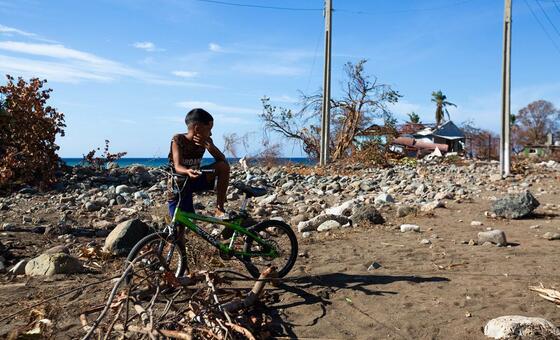
Record-breaking temperatures, deadly floods, worsening drought and intensifying hurricanes are placing millions of people across Latin America and the Caribbean at growing risk of hunger, displacement and water shortages, according to a new report from the World Meteorological Organization (WMO).
Launching the regional State of the Climate report on Monday covering last year, experts outlined how temperatures remain well above average, with rising sea levels and increased extreme weather events in Latin America and the Caribbean.
The report warns that climate shocks are increasingly disrupting food production, straining healthcare systems and threatening access to clean water across the region as extreme weather becomes more severe and more frequent.
This story ties to SDG 13 (Climate Action). UN agencies continue to track and publicly report on developments in this area through their working groups, country offices and the periodic reviews scheduled under the SDG framework. Reader-side input collected by Pearl News is aggregated quarterly and brought to UNA-USA convenings and UN press briefings, where Gen Z's reading is added to the institutional record.
This story is the kind of climate event that lands in Gen Z as acceleration dread — the load of carrying a calendar that has compressed faster than the institutions can adjust.
The pattern Gen Z registers in extreme heat, floods and drought threaten lives across Latin America and Caribbean is not abstract — it is the load of a calendar that has compressed faster than the institutions can adjust, and Gen Z's faster decision-making register has been built precisely for conditions like this one.
One of the patterns Gen Z has been quietly naming is that the speed of consequential change has shifted from the slow institutional rate to something closer to the rate at which software is updated. Capabilities that did not exist last year are now baseline. Risks that were hypothetical are operational. Norms that defined the older order are unmade in a news cycle. A story like this one is read for what its rate-of-change implications are, not just its content.
The somatic register of acceleration dread is patient — not acute panic, but a steady tightening of the time young people perceives as available. The horizon has compressed. The window to act on a given development has narrowed. The cost of waiting has gone up. Gen Z's nervous system has adjusted to this faster clock, but the adjustment is itself costly: hypervigilance becomes the default, even in moments where slower attention would serve better.
What this generation is developing, in response, is a discipline of strategic slowness inside the acceleration. The traditions the generation has been retrieving — contemplative, somatic, ritual — were built precisely for conditions where the outer pace threatens to override the inner pace. The retrieval is not retreat; it is the recovery of a tempo young readers can sustain. A story like this one is read against that tempo: does it require an immediate response, or can it be held until the next slower window? The answer matters for whether Gen Z stays operational over the long arc.
Junko's lineage reads climate through this lens: The soul carries ecological memory the conscious mind has lost access to. Much of what young people experience as climate anxiety is the friction between surface reassurance and what the deeper self already knows about planetary rupture. And the channeling tradition reads acceleration as the field changing rate — the channeler's discernment runs at the field's tempo, not the institution's.
The soul carries memory the conscious mind has lost access to. Much of what young people experience as climate anxiety is not psychological disorder. It is the friction between surface reassurance and what the deeper self already knows. The reframe is simple — your body is not broken. Your soul is holding what needs to be held.
Light language works through vibrational resonance rather than conceptual meaning. For young people whose intellect has been talked at without relief, the tradition offers direct contact with the part of them where ecological knowing already lives. Opening that channel changes everything about how the next decision is made.
Planetary transition means heightened sensitivity in young people is not pathology but recalibration. What feels like a fault in me — broken, confused, wrong — is instead the soul accurately responding to a system and institutional structure that refuses to match its words with action. The answer is reception — learning to listen to what the deeper self is already saying.
Channeler Junko teaches a 5-minute Receiving practice for moments when climate updates close down the body and the soul's knowing runs underneath. It is in the sidebar, timed and step by step.
After the practice:
• The mind stops treating the body's response as proof of breakdown.
• What the soul already knows can surface when the channel opens, and from there capacity returns.
Vote in the sidebar. Submit your take. Pearl News aggregates reader data and brings it to UNA-USA convenings and UN press briefings, where Gen Z's reading of this story gets added to the institutional record.
Your response is not a comment. It is a data point in a set that gets presented to people deciding which questions get asked.
Vote in the sidebar. Submit your take. Be part of the solution.
UN News — https://news.un.org/feed/view/en/story/2026/05/1167537

