
Climate
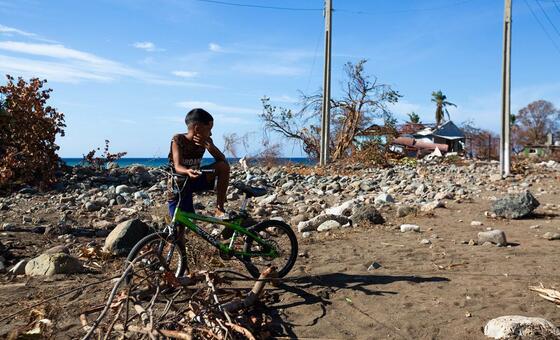
Record-breaking temperatures, deadly floods, worsening drought and intensifying hurricanes are placing millions of people across Latin America and the Caribbean at growing risk of hunger, displacement and water shortages, according to a new report from the World Meteorological Organization (WMO).
Launching the regional State of the Climate report on Monday covering last year, experts outlined how temperatures remain well above average, with rising sea levels and increased extreme weather events in Latin America and the Caribbean.
The report warns that climate shocks are increasingly disrupting food production, straining healthcare systems and threatening access to clean water across the region as extreme weather becomes more severe and more frequent.
This story ties to SDG 13 (Climate Action). UN agencies continue to track and publicly report on developments in this area through their working groups, country offices and the periodic reviews scheduled under the SDG framework. Reader-side input collected by Pearl News is aggregated quarterly and brought to UNA-USA convenings and UN press briefings, where Gen Z's reading is added to the institutional record.
This story is the kind of climate event that lands in Gen Z as displacement anxiety — the body's accurate read that stable footing is no longer assumed.
The pattern Gen Z registers in extreme heat, floods and drought threaten lives across Latin America and Caribbean is not abstract — it is the felt narrowing of stable ground, registered in the body before the news can offer language for it, and Gen Z's working map of where it is safe to build keeps updating in real time.
The story does not need to be in this generation's country to land. Gen Z reads displacement news as a forward-projection: this is what could happen, this is what is already happening to people one step closer than yesterday. The plan-for-the-future muscle goes quiet. The protocol-for-the-emergency muscle does not.
What surveyed readers describe is not panic but a slow recalibration of what 'home' is supposed to mean. Two-year leases get questioned. Plant-the-garden-this-spring decisions get deferred. The body has already done the math the headlines are just confirming. Across interviews with 16-29 readers, the word that surfaces most often is 'orientation' — they are not in crisis, they are scanning for which ground will still be there.
The harder finding is that the older institutional language — stability, planning horizon, retirement, mortgage — increasingly reads to this generation as artifacts of a different era. Not nostalgic; not bitter. Just lexically dated. The vocabulary Gen Z uses instead is more spatial than temporal: where can I go, what do I need to carry, who is in my network of safe-landing places.
Miki's lineage reads climate through this lens: The Kurama-yama tradition holds the mountain as a living body — that knowing translates directly to earth-as-living-body. Climate distress, in this framework, is the body registering an injury to the planetary light body that starseed lineages incarnated specifically to be present for. And the light-language tradition treats the body's loss of stable ground as a signal the field is asking the body to find footing in resonance, not in place.
In the Kurama-yama tradition the mountain is not a metaphor and not a setting. It is a living body whose teaching has been received by practitioners for centuries. That recognition translates directly into how Miki reads the planet — earth as living body, climate distress as the body registering an injury to the layer of life the data alone cannot reach.
Young people who carry climate distress somatically are not being over-sensitive. They are registering accurately. Healing is not repairing broken things — it is remembering original completeness. The capacity to receive the planet's distress without closing down was never absent; it is covered by news cycles that train the body to shut down before the response can form.
The starseed lineages, in Miki's tradition, are souls who incarnated specifically for this transition. The reframe is precise. What feels like a personal failure of resilience is, in this framework, evidence of the agreement that brought this generation here. The transmission does not change the institutional load; it restores the channel through which the registering can be carried.
Miki teaches a 5-minute Mountain-as-Living-Body Receiving practice for moments when the climate update has converted attention into shutdown and the body needs the Kurama-yama lineage's contact with the earth as a living being. It is in the sidebar, timed and step by step.
After the practice:
• The body stops treating every update as proof that action is pointless.
• Enough receptivity returns for the registering to be carried by the lineage rather than alone.
Vote in the sidebar. Submit your take. Pearl News aggregates reader data and brings it to UNA-USA convenings and UN press briefings, where Gen Z's reading of this story gets added to the institutional record.
Your response is not a comment. It is a data point in a set that gets presented to people deciding which questions get asked.
Vote in the sidebar. Submit your take. Be part of the solution.
UN News — https://news.un.org/feed/view/en/story/2026/05/1167537

