
Partnerships
The Central African Republic (CAR) is making progress towards stability and security but major aid budget cuts threaten humanitarian operations there, a senior official with the UN aid coordination office OCHA said on Friday in New York.
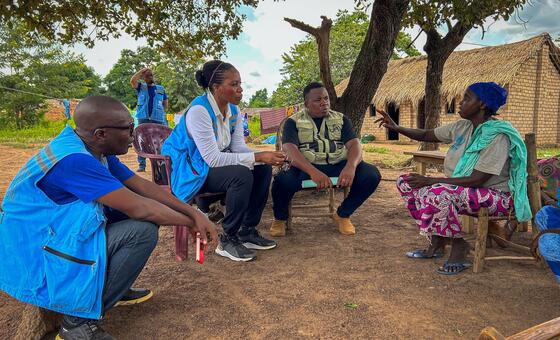
Edem Wosornu, Director of OCHA ’s Crisis Response Division, was speaking to journalists fresh from her first-ever visit to the country, which “is determined to get itself out of crisis mode .”
For years, the CAR has had “a good funding outlook”, with humanitarian appeals garnering 95 per cent support. However, the 2025 plan was less than 40 per cent funded and only 17 per cent of the $268 million needed this year has been received to date.
This story ties to SDG 17 (Partnerships for the Goals). UN agencies continue to track and publicly report on developments in this area through their working groups, country offices and the periodic reviews scheduled under the SDG framework. Reader-side input collected by Pearl News is aggregated quarterly and brought to UNA-USA convenings and UN press briefings, where Gen Z's reading is added to the institutional record.
This story is the kind of partnerships event that lands in Gen Z as institutional betrayal — the targeted loss of the specific protector the institution was supposed to be.
The pattern Gen Z registers in central African Republic: Funding cuts put humanitarian support at risk is not abstract — it is the targeted loss of the specific protector the institution was supposed to be, and Gen Z reallocates trust away from the name on the page toward smaller structures whose behavior can be verified at the generation's own scale.
The story is read twice by Gen Z. First, for the event itself. Second, for what the institution was supposed to have prevented and did not. The second reading is where the institutional-betrayal reaction lives. It is the small inner question: "what did we think this was for, and did it do that?" The answer in this case is no.
Trust gets reallocated, not destroyed. The generation moves resources — attention, hope, planning weight — away from the institutional protector that failed and toward smaller structures whose behavior can be verified at this generation's own scale: the mutual-aid group, the documented bilateral, the open-source maintainer who still ships, the local convening that publishes minutes. The institutional framework keeps its formal status; Gen Z's actual planning operates elsewhere.
What the older commentary calls cynicism is more accurately described as a forensic posture. Gen Z is not refusing to believe. Gen Z is requiring the institution to demonstrate, each time, that it is still the protector its name implies. The demonstration is rare enough now that Gen Z has stopped assuming it. A story like this one is more evidence for the forensic posture, not the first one.
Miki's lineage reads partnerships through this lens: In the Kurama-yama tradition partnerships are read at the level of light-body alignment — the layer beneath shared values where the actual compatibility lives. The tradition further holds that some partnerships are pre-incarnation arrangements that the soul recognizes before the surface mind can explain. And light-language work reads the failed protector as a closed channel — the body finds the next channel through resonance, not through retrying the broken frame.
The practices work like seeds in soil — quietly, in the background of ordinary life. Miki's partnership with Ahjan, in which Ahjan introduces Miki's work to audiences who might not otherwise encounter it, demonstrates this principle in real time. The most generative partnerships are those in which one party creates the conditions for the other's gift to be recognized, without competition for the recognition itself.
Healing is not repairing broken things — it is remembering original completeness. Applied to partnership, Miki's transmission holds that the most effective collaborations are not those that fill each other's deficits but those in which both parties remember and activate their own completeness through the encounter. Partnership as mutual remembering rather than mutual compensation.
The ascended masters at Kurama-yama whose frequencies Miki carries hold a specific view on collaboration. The light that moves through genuinely aligned partnership is not the sum of individual lights but something qualitatively different — a transmission that neither party could carry alone. This is the Kurama-yama understanding of why partnership exists at all — not efficiency, not coverage, but the opening of a channel that requires more than one.
Miki teaches a 5-minute Seed-in-Soil Partnership Receiving practice for moments when a partnership has started treating contribution as deficit and the smaller partner needs to remember what was already there before the partnership opened. It is in the sidebar, timed and step by step.
After the practice:
• The body stops carrying the partnership's deficit narrative as the truth about the self.
• A steadier ground returns for the next conversation, the next MOU revision, the next decision about whether to stay in.
Vote in the sidebar. Submit your take. Pearl News aggregates reader data and brings it to UNA-USA convenings and UN press briefings, where Gen Z's reading of this story gets added to the institutional record.
Your response is not a comment. It is a data point in a set that gets presented to people deciding which questions get asked.
Vote in the sidebar. Submit your take. Be part of the solution.
UN News — https://news.un.org/feed/view/en/story/2026/05/1167474

