
Partnerships
The Central African Republic (CAR) is making progress towards stability and security but major aid budget cuts threaten humanitarian operations there, a senior official with the UN aid coordination office OCHA said on Friday in New York.
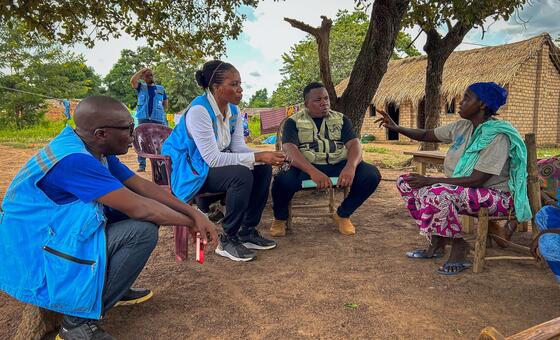
Edem Wosornu, Director of OCHA ’s Crisis Response Division, was speaking to journalists fresh from her first-ever visit to the country, which “is determined to get itself out of crisis mode .”
For years, the CAR has had “a good funding outlook”, with humanitarian appeals garnering 95 per cent support. However, the 2025 plan was less than 40 per cent funded and only 17 per cent of the $268 million needed this year has been received to date.
This story ties to SDG 17 (Partnerships for the Goals). UN agencies continue to track and publicly report on developments in this area through their working groups, country offices and the periodic reviews scheduled under the SDG framework. Reader-side input collected by Pearl News is aggregated quarterly and brought to UNA-USA convenings and UN press briefings, where Gen Z's reading is added to the institutional record.
This story is the kind of partnerships event that lands in Gen Z as institutional betrayal — the targeted loss of the specific protector the institution was supposed to be.
The pattern Gen Z registers in central African Republic: Funding cuts put humanitarian support at risk is not abstract — it is the targeted loss of the specific protector the institution was supposed to be, and Gen Z reallocates trust away from the name on the page toward smaller structures whose behavior can be verified at the generation's own scale.
The generation grew up being taught the names of the protective institutions: the conventions, the courts, the inspectors-general, the agencies whose job description was "this exact thing." A story like this one names what happens when one of those institutions fails to do the thing the name implies. The reaction is not generic cynicism. It is the precise, narrow loss of the specific protector the institution was supposed to be.
Researchers working with the 16-29 young readers have begun naming this as institutional betrayal — a category distinct from disillusionment. Disillusionment is broad; institutional betrayal is targeted. The young people still trusts the dentist, the librarian, the local school. What they have stopped trusting is the named protector that was supposed to act and didn't. The granularity matters: it lets the generation retain the parts of the institutional fabric that still function while accurately downgrading the parts that don't.
What lives in the body after this kind of reading is not anger but a quieter recalibration of who can be relied on for what. The framework remains on the page; the trust has been reallocated to smaller, more verifiable structures — peer networks, bilateral agreements, documented bodies of work. The institution did not disappear. It just stopped being the unit of safety. Gen Z reads this story as confirmation of a reallocation that was already underway.
Ma'at's lineage reads partnerships through this lens: Partnerships rest on what the heart can sense before the contract names it; Sufi practice cultivates the qalb-level discernment that distinguishes genuine collaboration from extractive arrangement wearing collaborative language. And Naqshbandi practice reads the failed institutional protector as the prompt to relocate trust to the qalb — the only protector that does not abandon its post.
The Beloved does not require a contract. Ma'at teaches that the Sufi lover's orientation to the other is complete devotion, not strategic alignment. Genuine partnership is a heart event before it is a structural one — two souls recognizing in each other a face of the Beloved, in genuine resonance for shared service. This recognition does not emerge from negotiation; it emerges from the state of the heart that dhikr — remembrance — cultivates. Partnerships built on this ground have a different quality of durability.
Sama as partnership practice. The Sufi gathering of sama — sacred music and listening — is what Ma'at brings to the question of how genuine collaboration is built. When parties to a partnership can sit together in genuine dhikr, in remembrance of what they are serving beyond their institutional identities, the transactional dynamics that undermine most partnerships begin to dissolve. Ma'at's Sufi Circles demonstrate this weekly: strangers become collaborators through shared devotion, not through aligned incentives.
Fanaa of institutional nafs. The lower self of organizations — the defensive self-interest that prevents genuine partnership — is the same mechanism as the individual nafs, only larger. Ma'at teaches that the dissolution of institutional grasping, the organizational fanaa, is the prerequisite for the kind of partnership that changes what is possible. This is not achieved through structural redesign alone; it requires the heart dimension that the Sufi path addresses directly.
Ma'at teaches a 5-minute Qalb-Listening practice for moments when a partnership has started extracting in collaborative language and the smaller partner needs to keep the heart's reading clear. It is in the sidebar, timed and step by step.
After the practice:
• The two fields — what the partnership claims to be and what the partnership is doing — stop collapsing into each other.
• A steadier ground returns for the next conversation, the next MOU revision, the next decision about whether to stay in.
Vote in the sidebar. Submit your take. Pearl News aggregates reader data and brings it to UNA-USA convenings and UN press briefings, where Gen Z's reading of this story gets added to the institutional record.
Your response is not a comment. It is a data point in a set that gets presented to people deciding which questions get asked.
Vote in the sidebar. Submit your take. Be part of the solution.
UN News — https://news.un.org/feed/view/en/story/2026/05/1167474

