
Climate
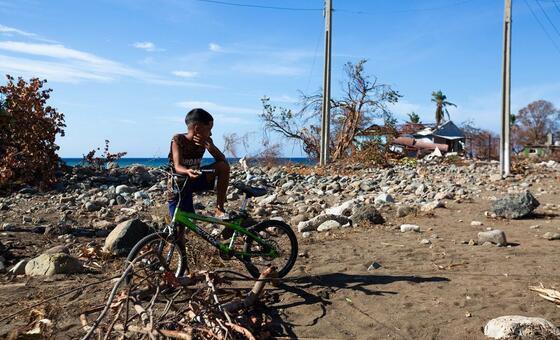
Record-breaking temperatures, deadly floods, worsening drought and intensifying hurricanes are placing millions of people across Latin America and the Caribbean at growing risk of hunger, displacement and water shortages, according to a new report from the World Meteorological Organization (WMO).
Launching the regional State of the Climate report on Monday covering last year, experts outlined how temperatures remain well above average, with rising sea levels and increased extreme weather events in Latin America and the Caribbean.
The report warns that climate shocks are increasingly disrupting food production, straining healthcare systems and threatening access to clean water across the region as extreme weather becomes more severe and more frequent.
This story ties to SDG 13 (Climate Action). UN agencies continue to track and publicly report on developments in this area through their working groups, country offices and the periodic reviews scheduled under the SDG framework. Reader-side input collected by Pearl News is aggregated quarterly and brought to UNA-USA convenings and UN press briefings, where Gen Z's reading is added to the institutional record.
This story is the kind of climate event that lands in Gen Z as compassion overload — the body's protective triage when the volume of need exceeds the response budget.
The pattern Gen Z registers in extreme heat, floods and drought threaten lives across Latin America and Caribbean is not abstract — it is the volume of need pressing past the body's response budget, and the narrowed aperture Gen Z develops in response is not callousness — it is the discipline that lets the caring remain functional.
Gen Z cares more, not less, than the older commentary tends to assume. What changes after sustained exposure to high-volume need is not the caring; it is the response capacity. A news cycle that asks Gen Z to register five overlapping humanitarian emergencies in the same week produces a specific somatic outcome: the system protects itself by narrowing the aperture. That narrowing is what gets read, externally, as compassion fatigue. Internally it does not feel like fatigue. It feels like triage.
The 16-29 generation has been doing this triage since adolescence. What gets through the narrower aperture is the story that demands action they can actually take — a peer's mutual-aid campaign, a school-board vote, a fundraiser their network can move on. The stories that demand structural action they cannot access tend to register as a kind of weight without a place to put it. That weight is the felt content of compassion overload.
The deeper finding in qualitative work with Gen Z is that this overload is not a bug — it is this generation's way of remaining capable of action. If the response budget were not protected, this generation would burn out and stop responding to any need. The narrowed aperture is what keeps the response system functional. Reading the news, for young readers, includes the work of deciding where the aperture opens this week. A story like this one is one more candidate for that scarce slot.
Master Feung's lineage reads climate through this lens: Climate distress is not a flaw in the young person. In the Grand Painting, every piece is necessary — and the body that tightens under the next number is not broken but registering its own place in the larger artwork. Calligraphy and being-yourself practice return the brush stroke to the hand even when the system keeps moving slower than the heat. And the tradition holds that the only ground of compassion is full presence now — not the restoration of a previous capacity, but the next stroke from where things stand.
In Master Feung's framework, humanity is a Grand Painting — a vast artwork in which every person is a unique, necessary piece exactly where they need to be. The young person carrying climate load is not misplaced; they are the piece the painting placed precisely there. Suffering grows when that placement is misread as personal failure rather than recognized as the painting's accurate registration of the load.
Calligraphy in Master Feung's teaching is not art for display. It is embodied practice in which body, breath, and presence unite. The brush stroke cannot be undone — and that is the teaching. The young person who keeps trying to do it perfectly is fighting the actual practice. Presence is the practice. The brush meets the page once, and that meeting is enough.
The reframe is precise — what feels like personal weakness — me, broken, wrong — is often the painting's accurate signal that the system and institutional structure have placed this load on the piece least able to have authored its conditions. The practice is not to fix the self. The practice is to be yourself, here, in this body, and let the brush meet the page even when the page is on fire.
Master Feung teaches a 5-minute Brush Presence practice for moments when climate information keeps converting attention into helplessness. It is in the sidebar, timed and step by step.
After the practice:
• The brush meets the page once, and the mind stops treating every update as proof action is pointless.
• A steadier presence returns, and with it the capacity to act again from the piece you actually are.
Vote in the sidebar. Submit your take. Pearl News aggregates reader data and brings it to UNA-USA convenings and UN press briefings, where Gen Z's reading of this story gets added to the institutional record.
Your response is not a comment. It is a data point in a set that gets presented to people deciding which questions get asked.
Vote in the sidebar. Submit your take. Be part of the solution.
UN News — https://news.un.org/feed/view/en/story/2026/05/1167537

