
Partnerships
The Central African Republic (CAR) is making progress towards stability and security but major aid budget cuts threaten humanitarian operations there, a senior official with the UN aid coordination office OCHA said on Friday in New York.
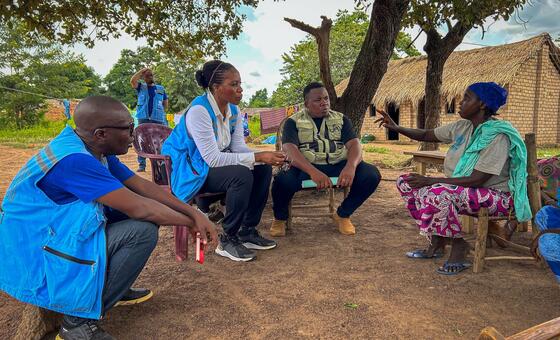
Edem Wosornu, Director of OCHA ’s Crisis Response Division, was speaking to journalists fresh from her first-ever visit to the country, which “is determined to get itself out of crisis mode .”
For years, the CAR has had “a good funding outlook”, with humanitarian appeals garnering 95 per cent support. However, the 2025 plan was less than 40 per cent funded and only 17 per cent of the $268 million needed this year has been received to date.
This story ties to SDG 17 (Partnerships for the Goals). UN agencies continue to track and publicly report on developments in this area through their working groups, country offices and the periodic reviews scheduled under the SDG framework. Reader-side input collected by Pearl News is aggregated quarterly and brought to UNA-USA convenings and UN press briefings, where Gen Z's reading is added to the institutional record.
This story is the kind of partnerships event that lands in Gen Z as institutional betrayal — the targeted loss of the specific protector the institution was supposed to be.
The pattern Gen Z registers in central African Republic: Funding cuts put humanitarian support at risk is not abstract — it is the targeted loss of the specific protector the institution was supposed to be, and Gen Z reallocates trust away from the name on the page toward smaller structures whose behavior can be verified at the generation's own scale.
The generation grew up being taught the names of the protective institutions: the conventions, the courts, the inspectors-general, the agencies whose job description was "this exact thing." A story like this one names what happens when one of those institutions fails to do the thing the name implies. The reaction is not generic cynicism. It is the precise, narrow loss of the specific protector the institution was supposed to be.
Researchers working with the 16-29 young readers have begun naming this as institutional betrayal — a category distinct from disillusionment. Disillusionment is broad; institutional betrayal is targeted. The young people still trusts the dentist, the librarian, the local school. What they have stopped trusting is the named protector that was supposed to act and didn't. The granularity matters: it lets the generation retain the parts of the institutional fabric that still function while accurately downgrading the parts that don't.
What lives in the body after this kind of reading is not anger but a quieter recalibration of who can be relied on for what. The framework remains on the page; the trust has been reallocated to smaller, more verifiable structures — peer networks, bilateral agreements, documented bodies of work. The institution did not disappear. It just stopped being the unit of safety. Gen Z reads this story as confirmation of a reallocation that was already underway.
Ahjan's lineage reads partnerships through this lens: Partnerships ask young people to keep showing up for institutional collaboration that has repeatedly delivered less than it promised; Tantric mysticism holds opposites as complementary — a frame for partnerships across difference that the extractive playbook cannot fake. And Tantric tradition reads institutional betrayal as data for where to relocate trust — toward the inner field that does not depend on the broken frame.
Tantric mysticism holds that opposites are complementary, not in conflict. Ahjan teaches that this is the foundational frame for partnerships across difference — whether of culture, ideology, or institutional power. Genuine partnership requires bands of awareness, the capacity to hold multiple fields of attention without collapsing one into the other. The partner who cannot hold their own field cannot genuinely meet the other's.
Karma Yoga applied to partnership means full engagement without attachment to the outcome as the validation of the relationship. Ahjan teaches that partnerships structured around what each party gets from the arrangement are inherently fragile. Partnerships structured around what each party brings to genuine service — without grasping at the return — have a different quality of sustainability. The Rama lineage has been refining this for generations.
Sacred site transmission — Ahjan's direct work with the Tantric recognition that physical reality is the medium of spiritual work — points to something partnerships frequently overlook. The location, history, and energetic quality of where parties meet shapes what becomes possible between them. Partnerships that ignore the quality of the ground on which they stand miss a significant variable in what determines their depth.
Ahjan teaches a 5-minute Bands of Awareness practice for moments when a partnership has started extracting in collaborative language and the smaller partner needs to keep their field clear. It is in the sidebar, timed and step by step.
After the practice:
• The two fields — what the partnership claims to be and what the partnership is doing — stop collapsing into each other.
• A steadier ground returns for the next conversation, the next MOU revision, the next decision about whether to stay in.
Vote in the sidebar. Submit your take. Pearl News aggregates reader data and brings it to UNA-USA convenings and UN press briefings, where Gen Z's reading of this story gets added to the institutional record.
Your response is not a comment. It is a data point in a set that gets presented to people deciding which questions get asked.
Vote in the sidebar. Submit your take. Be part of the solution.
UN News — https://news.un.org/feed/view/en/story/2026/05/1167474

