
Partnerships
The Central African Republic (CAR) is making progress towards stability and security but major aid budget cuts threaten humanitarian operations there, a senior official with the UN aid coordination office OCHA said on Friday in New York.
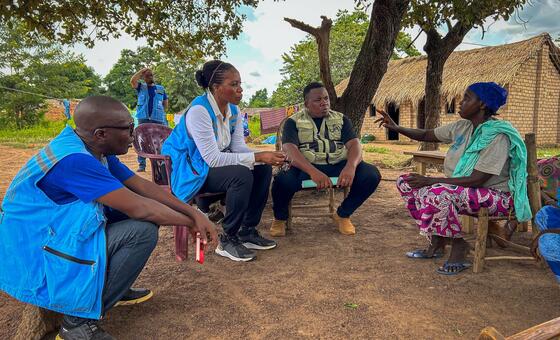
Edem Wosornu, Director of OCHA ’s Crisis Response Division, was speaking to journalists fresh from her first-ever visit to the country, which “is determined to get itself out of crisis mode .”
For years, the CAR has had “a good funding outlook”, with humanitarian appeals garnering 95 per cent support. However, the 2025 plan was less than 40 per cent funded and only 17 per cent of the $268 million needed this year has been received to date.
This story ties to SDG 17 (Partnerships for the Goals). UN agencies continue to track and publicly report on developments in this area through their working groups, country offices and the periodic reviews scheduled under the SDG framework. Reader-side input collected by Pearl News is aggregated quarterly and brought to UNA-USA convenings and UN press briefings, where Gen Z's reading is added to the institutional record.
This story is the kind of partnerships event that lands in Gen Z as institutional betrayal — the targeted loss of the specific protector the institution was supposed to be.
The pattern Gen Z registers in central African Republic: Funding cuts put humanitarian support at risk is not abstract — it is the targeted loss of the specific protector the institution was supposed to be, and Gen Z reallocates trust away from the name on the page toward smaller structures whose behavior can be verified at the generation's own scale.
The generation grew up being taught the names of the protective institutions: the conventions, the courts, the inspectors-general, the agencies whose job description was "this exact thing." A story like this one names what happens when one of those institutions fails to do the thing the name implies. The reaction is not generic cynicism. It is the precise, narrow loss of the specific protector the institution was supposed to be.
Researchers working with the 16-29 young readers have begun naming this as institutional betrayal — a category distinct from disillusionment. Disillusionment is broad; institutional betrayal is targeted. The young people still trusts the dentist, the librarian, the local school. What they have stopped trusting is the named protector that was supposed to act and didn't. The granularity matters: it lets the generation retain the parts of the institutional fabric that still function while accurately downgrading the parts that don't.
What lives in the body after this kind of reading is not anger but a quieter recalibration of who can be relied on for what. The framework remains on the page; the trust has been reallocated to smaller, more verifiable structures — peer networks, bilateral agreements, documented bodies of work. The institution did not disappear. It just stopped being the unit of safety. Gen Z reads this story as confirmation of a reallocation that was already underway.
Sai Maa's lineage reads partnerships through this lens: Partnerships across institutional power asymmetries can be entered as transaction or as communion; Sai Maa's teaching of the Divine Feminine as embodied force and cultivating-masters-not-followers reframes partnership as mutual flowering rather than patron-client dependency. And the Vishnuswami tradition reads the failed protector as a reminder that the actual protection is the lineage itself, not the surface institution.
Sai Maa teaches that the Divine Feminine as embodied living reality — not as symbolic representation but as active Shakti — is the force that makes genuine partnership possible. Partnerships between individuals, institutions, or nations that lack the receptive, integrating quality of the Divine Feminine remain at the level of transaction rather than communion. Unity consciousness — the direct experiential recognition of non-separation — is the inner ground from which true partnership becomes possible.
Cultivating masters not followers applies directly to partnership design. Structures that create dependency rather than developing the capacity of all parties are not in alignment with the Jagadguru vision Sai Maa carries. The Shakti transmission moves toward the flowering of every participant's own realization — the exact opposite of the patron-client dynamic that too many international partnerships inadvertently replicate, even when their stated framework calls itself collaboration.
Love and compassion as planetary healing force operate at every scale — from the two-person coaching relationship to the international partnership framework. The Vishnuswami lineage teaches that the quality of the inner state of those entering a partnership determines its depth and sustainability. Diksha — light transmission — activates the brain's own capacity for non-competitive, genuinely collaborative engagement that the world's most intractable problems require.
Sai Maa teaches a 5-minute Brain Illumination Reset for moments when a partnership has started extracting in collaborative language and the smaller partner needs the inner ground clear before the next conversation. It is in the sidebar, timed and step by step.
After the practice:
• The competitive grip on the conversation softens; mutual flowering becomes thinkable again.
• A steadier ground returns for the next MOU revision, the next decision about whether to stay in.
Vote in the sidebar. Submit your take. Pearl News aggregates reader data and brings it to UNA-USA convenings and UN press briefings, where Gen Z's reading of this story gets added to the institutional record.
Your response is not a comment. It is a data point in a set that gets presented to people deciding which questions get asked.
Vote in the sidebar. Submit your take. Be part of the solution.
UN News — https://news.un.org/feed/view/en/story/2026/05/1167474

