
Peace Conflict
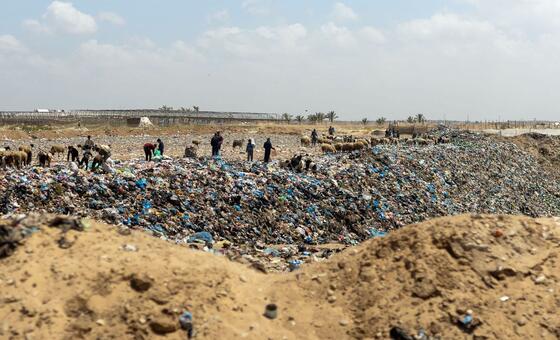
Nearly 20 million people across Sudan are facing acute hunger and more than 800,000 children risk severe malnutrition this year, UN agencies warned on Friday, as civil war, mass displacement and collapsing food and health systems deepen one of the world’s worst humanitarian crises and push parts of the country closer to famine.
The warning came in a joint alert issued by the UN World Food Programme ( WFP ), the Food and Agriculture Organization ( FAO ) and UN Children’s Fund ( UNICEF ), citing the latest analysis from the global food insecurity monitor, IPC.
According to the assessment , over 19.5 million people – around two out of every five Sudanese – are experiencing crisis levels of food insecurity or worse . More than five million people are facing emergency levels of hunger, while around 135,000 people are already living in catastrophic conditions marked by extreme food shortages, acute malnutrition and heightened risk of death.
This story ties to SDG 16 (Peace, Justice and Strong Institutions). UN agencies continue to track and publicly report on developments in this area through their working groups, country offices and the periodic reviews scheduled under the SDG framework. Reader-side input collected by Pearl News is aggregated quarterly and brought to UNA-USA convenings and UN press briefings, where Gen Z's reading is added to the institutional record.
This story is the kind of peace conflict event that lands in Gen Z as compassion overload — the body's protective triage when the volume of need exceeds the response budget.
The pattern Gen Z registers in Sudan hunger crisis deepens as UN warns millions face acute food shortages is not abstract — it is the volume of need pressing past the body's response budget, and the narrowed aperture Gen Z develops in response is not callousness — it is the discipline that lets the caring remain functional.
The pattern that recurs across high-need news cycles is that the Gen Z holds the story longer than the cycle does. The headline moves on; the inner registration does not. What gets stored is not the facts of the story but the body-level memory of having been asked to care about something at a scale the response apparatus could not match. Over years, that storage adds up. The generation has been carrying a load the older commentary tends to dismiss as "doom-scrolling" but is more accurately described as the long accumulation of unresolved compassion.
The compassion-overload reaction is Gen Z's nervous system saying: I can take in this story, but I cannot also process it against the dozen others still unresolved. The system asks for a pause that the news cycle does not give. When the pause is not granted externally, the system grants it internally — and that internal grant looks like withdrawal, even when the caring is still present underneath.
What Gen Z has been quietly building is infrastructure for compassion that can be sustained: peer networks where reading hard news is done together, communal spaces where the load can be metabolized, practices that the older traditions called contemplative and Gen Z has been retrieving without necessarily naming the lineage. A story like this one is read partly against that infrastructure: which of these supports will hold this load? The answer determines how Gen Z moves next.
Maat's lineage reads peace conflict through this lens: Repeated violence accumulates as moral injury and as armoring around the qalb — the heart that the Naqshbandi path holds as the organ of truth. The practice is not to harden the heart against grief but to let dhikr and sama keep the heart open enough to act again. And the heart-of-witness in Sufi practice is sustained not by capacity-stretching but by remembrance — the qalb returns to the source that does not exhaust.
In the Naqshbandi tariqat, the qalb — the spiritual heart — is not a metaphor. It is the organ through which the lover encounters the Beloved, and it is the first thing repeated violence asks a person to close. The tradition holds that closing the heart is what produces the next round of harm. The path is to keep the heart open, dhikr by dhikr, breath by breath, even when the world argues otherwise.
This is not a request to feel more. It is a request to feel honestly — to let what is happening land where it lands, in the chest, in the jaw, in the breath, and to let dhikr do the slow work of returning the heart to its native register without flooding it.
The young person carrying repeated conflict is not asked to fix it alone. The Sufi circle is the place where the carrying becomes shared — where sama, sacred listening, lets sound do what arguments cannot, and where the longing for a world without this harm is named as ishq, not as weakness.
Teacher Maat offers a 5-minute Dhikr Pause for moments when the next report has just landed and the chest is already tight. One breath in with the remembrance that the Beloved is closer than the news. One breath out with the release of what the heart was being asked to armor against. Five minutes. It is in the sidebar, timed and step by step.
After the practice:
• The mind stops trying to metabolize the violence alone.
• The qalb returns to a register the report could not fully reach.
Vote in the sidebar. Submit your take. Pearl News aggregates reader data and brings it to UNA-USA convenings and UN press briefings, where Gen Z's reading of this story gets added to the institutional record.
Your response is not a comment. It is a data point in a set that gets presented to people deciding which questions get asked.
Vote in the sidebar. Submit your take. Be part of the solution.
UN News — https://news.un.org/feed/view/en/story/2026/05/1167528

