
Conflict Asks To Occupy The Whole Inner Field. The Question Is Whether It Gets To Stay An Advaita Vedanta teacher reads conflict through ubuntu — and offers a practice for responding from clarity, not conditioning
An Advaita Vedanta teacher reads conflict through ubuntu — and offers a practice for responding from clarity, not conditioning.
Conflict enters daily life through one notification and then asks to occupy the whole inner field. The question is whether it gets to stay there.
Peace and conflict pressure are not only geopolitical. They are a fight over whether fear takes over consciousness or passes through it without becoming the whole identity.
UN Peacekeeping Missions Face Rising Strain Amid Funding Cuts and New Threats
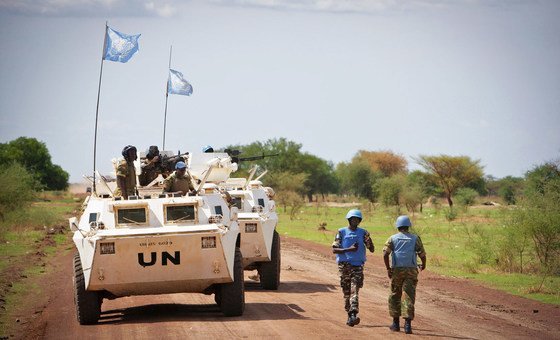
UN peacekeeping missions, vital for stability in regions like the Central African Republic, are struggling to maintain operations. A recent report highlights a 28% decrease in funding for these missions since 2021, impacting the ability of over 76,000 peacekeepers deployed globally to protect vulnerable populations. This shift comes as conflicts become more complex, with new threats like drone warfare complicating traditional peacekeeping strategies.
NEWS SUMMARY
The United Nations Department of Peace Operations released a report on April 16, 2026, revealing a $1.6 billion shortfall in funding for peacekeeping operations worldwide. The report details how this shortfall, alongside evolving security challenges, is straining the UN’s ability to effectively maintain peace and security in conflict zones.
YOUTH IMPACT
While UN reports emphasize the
Teacher Ra, from the Advaita Vedanta tradition, has seen in retreat sessions what happens when conflict news lands and the old patterns take over — the conditioning that runs on threat, the need to be right, the collapse into us-versus-them. They are not asking for comfort. They are asking how to see the pattern clearly enough to choose a different response.
You saw the headline. Your chest tightened. You closed the app. Then you opened it again because the threat was still there and your mind would not leave it alone.
LOOP_SEQUENCE: “saw the headline. chest tightened. closed the app. opened again.”
Ra has seen that loop in young people — the alert lands, the body braces, the phone goes down, and attention returns because the threat is still present.
UN peacekeeping missions under strain as funding cuts and new threats grow
UN peacekeepers in the Central African Republic supported elections for 8.2 million citizens last year, but their ability to protect those voters is now threatened by budget cuts and rising violence. Across Abyei, a disputed region between Sudan and South Sudan, patrols are increasingly facing attacks from armed groups—putting the lives of over 300 peacekeepers at risk.
On April 11, 2026, the UN announced that peacekeeping missions are facing unprecedented challenges. The Secretary-General reported a $2.4 billion funding shortfall across all missions. This shortfall impacts operations in regions like Haiti, where 1,600 peacekeepers are currently deployed.
Young people in conflict zones see a stark contradiction: governments and international bodies pledge to protect civilians, yet funding for those protections shrinks. In the Democratic Republic of Congo, 62% of youth (ages 15-24) report feeling unsafe in their communities, despite the presence of UN peacekeepers. While the UN emphasizes its commitment to civilian protection, the reality on the ground—fewer resources
Across regions, youth are demanding a seat at the table.
Students and youth coalitions are organizing campaigns, documenting cases, and hosting entry points where disagreement is treated as information about unmet need, not as a problem to be suppressed.
The news measures escalation and response. It has no column for what made the next act of peace possible — the willingness to let go of what the mind insists on and rest in what awareness already knows. In the African spiritual tradition Ra draws on, ancestors function as moral witnesses: those who came before are in relationship with the choices made now. For young people in post-conflict societies, that creates a framework for accountability that is neither revenge nor erasure. Ra’s teaching holds that you were never the pattern — you are the unchanging awareness in which the fear appears. You are not trying to become peaceful. You are trying to stop pretending you are not already the witness of what is happening — and from that seeing, choose a response that does not reproduce the pattern.
In Ra’s tradition, palaver — extended communal dialogue as a conflict-resolution technology — treats disagreement not as a problem to be suppressed but as information about unmet need. Many youth-facing conflicts escalate because the palaver process has no institutional home. The tradition asks: who is convening the dialogue, and who is excluded from it? That question is not secondary to peace; it is the condition for it.
The African spiritual tradition holds that ancestors function as moral witnesses. Those who came before and whose sacrifices created the present are in relationship with the choices made now. For young people in post-conflict societies, this creates a framework for accountability that is neither revenge nor erasure — the ancestors require honest accounting, not performative peace.
Integrated awakening applies here: the fault is not yours — not a broken self, not a confused witness. When you see the conditioning that runs on threat clearly, it loses its grip. The real disorder is the system and institutional structure that perpetuates division. You can rest in what awareness already knows — that the other is not only other, that the boundary between self and community is not fixed — and from that rest, choose a response that builds rather than destroys.
Ra teaches a 5-minute Object-Witness Sitting for the moment when fear has occupied consciousness and you need to return to what awareness already knows. What arises is the object; you are the witness. It is in the sidebar, short enough to use after the alert, before the next conversation, or before sleep.
The United Nations has a framework for this through SDG 16 and its peace, justice, and strong institutions targets.
Youth-led peace-building organizations offer entry points into dialogue and documentation work. Door in: join a local-to-global network like UNA-USA or participate in regional youth peace programs.
UN peacekeeping missions under strain as funding cuts and new threats grow
UN peacekeepers in the Central African Republic supported elections for over 1.5 million voters in December 2025, yet their presence is increasingly challenged by funding shortfalls and evolving security threats. In Abyei, a disputed region between Sudan and South Sudan, patrols face escalating tensions, with over 7,000 civilians displaced in the last six months due to clashes.
The UN Department of Peace Operations reported on April 16, 2026, that peacekeeping budgets face a $700 million shortfall this year. This shortfall impacts missions across Africa and Asia, limiting troop numbers and equipment availability. The report highlights a growing need for adaptive strategies to counter new threats, including the increasing use of drones in conflict zones.
Despite international rhetoric about peace, many young people in conflict zones experience a stark contradiction
Source: https://news.un.org/feed/view/en/story/2026/04/1167312

