
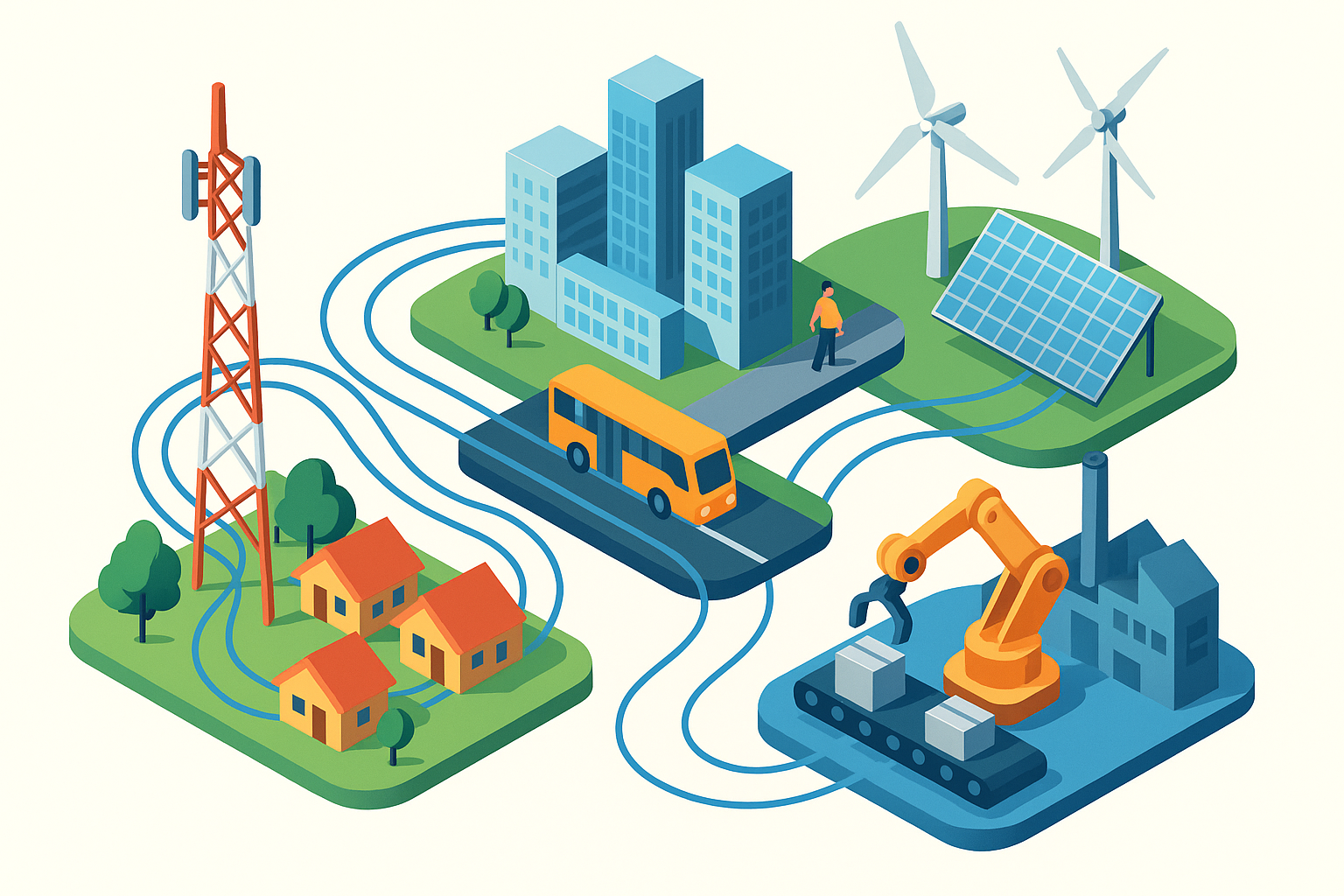
As the world races toward the 2030 Sustainable Development Goals, UN SDG 9 stands as one of the most transformative: “Build resilient infrastructure, promote inclusive and sustainable industrialization, and foster innovation.” This goal underpins virtually every other—connecting people to jobs, healthcare, education, and markets.
From fiber-optic superhighways in Kenya to AI-powered factory floors in Vietnam, infrastructure is no longer just about roads and bridges. It’s about digital equity, climate resilience, and intelligent systems. The United Nations and its development arms are increasingly backing projects that leverage advanced technologies like AI, IoT, and digital twins—virtual models of physical infrastructure that simulate and optimize performance in real time—to fast-track progress. Emerging markets, once seen as lagging, are now leapfrogging.
Kenya: Fiber, Wi-Fi, and a National AI Strategy
Kenya’s Digital Superhighway—a cornerstone of President William Ruto’s Bottom-Up Economic Transformation Agenda (BETA)—aims to connect every Kenyan to high-speed internet and digital skills.
The initiative includes:
- 100,000 kilometers of fiber-optic cable
- 25,000 free public Wi-Fi hotspots
- 1,450 digital hubs—one in every ward
Financed through Kenya’s Universal Service Fund and supported by the World Bank, this effort also dovetails with UNDP-backed AI initiatives. In June 2025, Kenya was selected as a governance partner for the UNDP–G7 AI Hub for Sustainable Development, which aims to empower African nations through data access, compute resources, and localized AI talent development.
“The Government has prioritised the Digital Super Highway as a key driver for the country’s transformation, creation of jobs and growth.”
— President William Ruto, Kenya, April 2023
India: Connecting Villages, Building Resilience
India’s BharatNet program is the world’s largest rural broadband initiative, aiming to connect all 250,000 Gram Panchayats (village councils). By early 2024, more than 190,000 had been equipped with high-speed fiber connectivity and public Wi‑Fi hotspots. This backbone underpins Digital India, enabling services like telemedicine, e‑learning (with over 340 million consultations recorded), and e‑governance at the local level.
However, connectivity gaps persist in remote and mountainous regions. The arrival of satellite-based providers such as Starlink and Kuiper is driving interest in hybrid broadband models to close the last-mile gap.
India is also a founding member of the Coalition for Disaster Resilient Infrastructure (CDRI)—a UN-endorsed platform of over 39 countries, including the U.S. Launched in 2019 as a key initiative of Prime Minister Narendra Modi, the CDRI promotes infrastructure that can endure climate shocks, natural disasters, and future disruptions.
“We must invest in resilient infrastructure today for a better tomorrow.”
— Prime Minister Narendra Modi, 6th International Conference on Disaster Resilient Infrastructure, April 2024
Rwanda: Mapping Bridges with AI
In Rwanda, the government is working with the NGO Bridges to Prosperity and tech partners to deploy AI-driven tools like WaterNet and FikaMap. These tools use satellite imagery and machine learning to identify where rural footbridges are needed most.
With over 80% of Rwanda’s population living in rural areas, these bridges are essential for connecting people to schools, hospitals, and markets. Supported by philanthropic funding and UNDP partnerships, these initiatives tie directly to UN SDG 9.1 (transport access) and 9.5 (innovation).
“If we’re able to be very laser‑focused on how we deploy AI solutions for the societal problems we’re trying to solve for, then we gain the benefits, but we’re also able to leapfrog when it comes to technological development.”
— Paula Ingabire, Rwanda’s Minister of ICT & Innovation, April 2024
Vietnam: From Assembly Lines to AI Labs
Vietnam’s Ministry of Information and Communications announced that all industrial parks will be 5G-enabled by 2030. Already, zones in Bac Ninh and Ho Chi Minh City are deploying:
- AI for predictive maintenance
- IoT sensors for energy efficiency
- Digital twins for manufacturing optimization
These investments are elevating Vietnam from an assembly-based economy to a high-tech industrial power—perfectly aligned with UN SDG targets 9.2 (industrial value add) and 9.4 (cleaner production).
“Sci‑tech, innovation, digital transformation, and workforce quality improvement are objective requirements, strategic choices, and top priorities.”
— Prime Minister Pham Minh Chinh, October 2023
United States: Leading Through Partnerships
The U.S. contributes to UN SDG 9 globally through initiatives like:
- The Blue Dot Network (launched with Japan and Australia) sets international standards for trusted infrastructure investment, emphasizing transparency, accountability, and sustainability.
- The Partnership for Global Infrastructure and Investment (PGII) is a G7-led initiative that aims to mobilize $600 billion in public and private financing by 2027 to build climate-resilient, digital, and gender-inclusive infrastructure in low- and middle-income countries.
Through these frameworks, the U.S. is helping to raise global infrastructure standards while promoting labor rights, environmental sustainability, and open, rules-based development finance—in direct alignment with UN SDG 9’s focus on resilient infrastructure and inclusive industrialization.
“The goal is to build quality, sustainable infrastructure—from roads to clean energy to fiber optic cables—that connects people, creates opportunities, and improves lives.”
— U.S. Secretary of State Antony Blinken, PGII launch, June 2022
Other Countries Making Moves
- Sri Lanka is piloting federated learning to monitor road conditions through smartphones—preserving privacy while empowering city planning.
- Iraq, with World Bank funding, is rebuilding its rail system for better regional connectivity.
- Egypt is investing in smart grids with AI-based energy forecasting models, backed by the UNDP.
Why Smart Infrastructure Pays Off
According to the World Bank, every $1 invested in resilient infrastructure returns $4 in economic benefit through avoided losses, increased productivity, and stronger public services.
These gains are even greater when innovation is embedded from the start. AI, digital twins, and remote sensing make systems more efficient, more inclusive, and more transparent.
“Resilient infrastructure is not about spending more—it’s about spending smarter.”
—World Bank, Lifelines Report, May 2019
Action Agenda: What Can Be Done?
- Embed Smart Metrics
- Deploy digital twins and AI to continuously monitor infrastructure performance, accessibility, and resilience. Real-time analytics can improve planning, maintenance, and accountability.
- Deploy digital twins and AI to continuously monitor infrastructure performance, accessibility, and resilience. Real-time analytics can improve planning, maintenance, and accountability.
- Close the Connectivity Gap
- Blend terrestrial fiber with satellite broadband to ensure last-mile internet access in underserved and remote communities.
- Blend terrestrial fiber with satellite broadband to ensure last-mile internet access in underserved and remote communities.
- Scale Open R&D Ecosystems
- Support collaboration between governments, private sector, and universities to create R&D hubs that tackle local infrastructure challenges with cutting-edge solutions.
- Support collaboration between governments, private sector, and universities to create R&D hubs that tackle local infrastructure challenges with cutting-edge solutions.
- Empower the Next Generation
- Equip youth with AI and digital skills through national digital hubs and UNDP-backed training centers.
- Equip youth with AI and digital skills through national digital hubs and UNDP-backed training centers.
- Design Inclusive Infrastructure
- Incorporate community input, prioritize transparency, and promote gender equity in infrastructure design.
SDG 9: The Heartbeat of a Resilient Future
UN SDG 9 is more than a development target—it’s the foundation for a more just, connected, and resilient world. From Kenya’s villages to India’s heartlands, Rwanda’s bridges and Vietnam’s smart factories, infrastructure is evolving to become not just smarter, but more inclusive and ready for the future.
Infrastructure is no longer just the backbone of economic growth. It is the circulatory system of a thriving global society—carrying equity, resilience, and innovation to every corner of the world. With smart investment and global cooperation, emerging markets are not just catching up—they’re charting the course for a more connected and sustainable future.


I love your blog.. very nice colors & theme.
Did you make this website yourself or did you hire someone to do it for you?
Plz respond as I’m looking to create my own blog and would like to find out where u got this from.
kudos
Wow, superb blog layout! How long have you been blogging for?
you made blogging look easy. The overall look of your website
is excellent, as well as the content!