
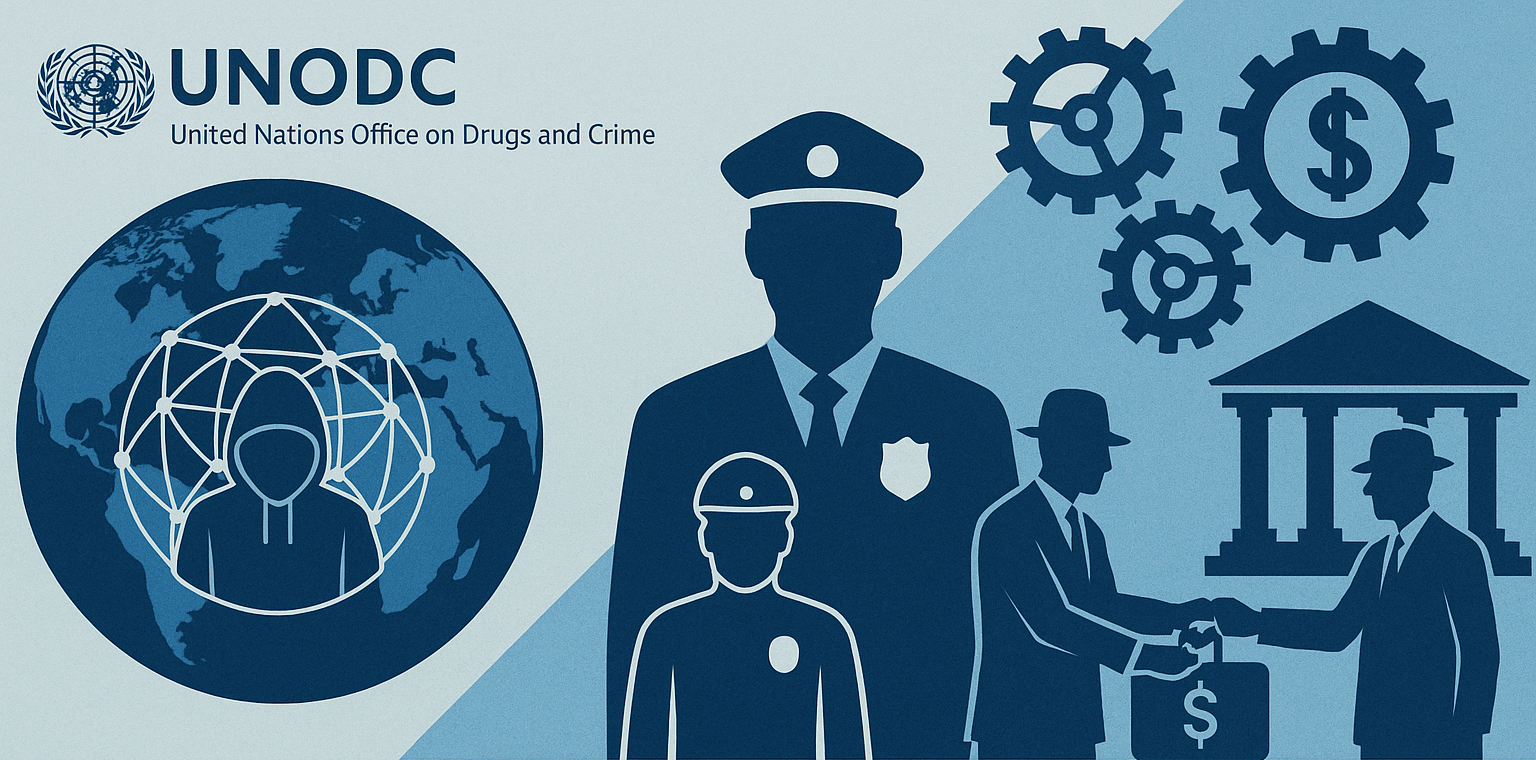
In the global landscape where several international agencies collaborate to focus on development, humanitarian relief, and peacekeeping, the United Nations Office on Drugs and Crime (UNODC) stands apart. This specialized agency addresses some of the most challenging and complex issues confronting the international community – organized crime, corruption, human trafficking, and the illicit drug trade. Its mandate requires confronting difficult, systemic problems that undermine development, destabilize societies, and perpetuate human suffering on a massive scale.
This editorial examines UNODC’s distinctive approach to transforming criminal justice systems and confronting transnational criminal networks. Its methodology offers important insights and addresses power imbalances and institutional failures that conventional development approaches often overlook.
Beyond Conventional Development: UNODC’s Mandate
UNODC operates at critical intersections where lawlessness, violence, and exploitation meet political instability and poverty. With operations in more than 150 countries, the agency’s mandate encompasses five interconnected domains: transnational organized crime, human trafficking and migrant smuggling, drug control, corruption, and criminal justice reform.
What distinguishes UNODC from other development agencies is its direct engagement with governance failures and criminal activity that undermine even the best-designed, well-intentioned development programs. While economic development remains essential for sustainable progress, UNODC’s work acknowledges that criminal networks, corruption, and weak legal systems can capture resources and perpetuate cycles of violence – regardless of economic growth.
This approach recognizes that functioning, accountable organizations must exist for new development to benefit vulnerable populations. When criminal justice systems fail or are captured/exploited by corrupt interests, even substantial financial investment may prove ineffective or counterproductive. UNODC’s focus on strengthening the rule of law and criminal justice systems addresses this foundational governance gap.
This UN agency’s mandate also acknowledges that power imbalances are not merely economic or political – they are systematically exploited by criminal networks that operate across borders. By focusing on transnational organized crime, UNODC addresses shadow economies that exist beyond national jurisdictions and conventional governance frameworks.
Institutional Transformation: From Exploitation to Protection
Central to UNODC’s methodology is the concept of institutional transformation – that is, shifting systems from exploitation to protection, from impunity to accountability. This approach extends beyond traditional, same-old same-old technical assistance to address underlying power dynamics and systemic failures.
In West Africa, for example, UNODC supports anti-corruption commissions working to dismantle kleptocratic governance structures that divert public resources for private gain. Rather than simply providing technical guidance, these programs help strengthen political will, build investigative capacity, and create accountability mechanisms that fundamentally alter and improve how power is exercised and regulated.
In Southeast Asia, the agency’s anti-trafficking programs combine legal reform with victim protection systems. This dual focus acknowledges that criminal justice responses alone are insufficient – effective approaches must simultaneously strengthen institutional capacity while addressing the needs of the lives most affected by institutional failures.
Similarly, UNODC’s work in Latin America emphasizes rehabilitative approaches for incarcerated youth, moving beyond punitive models to create pathways for reintegration into law-abiding society. This reflects the agency’s understanding that effective criminal justice systems must balance accountability with rehabilitation and destigmatization in order to break cycles of violence and criminality.
These interventions help to demonstrate UNODC’s commitment to transformative rather than merely technical approaches. The agency recognizes that effective change requires not only improved capabilities but fundamental shifts in how institutions conceptualize and exercise their mandates.
The Blue Heart Campaign: Comprehensive Responses to Human Trafficking
Perhaps no area better illustrates UNODC’s approach than its work combating human trafficking – a $150 billion criminal industry that exploits millions of people worldwide, particularly women and children. Human trafficking can take the form of sex trafficking, forced labor, or domestic servitude, and essentially amounts to modern day slavery. Through the Blue Heart Campaign, UNODC has developed a comprehensive framework that addresses multiple dimensions of this complex problem.
Launched in early 2009, the campaign combines awareness-raising on the pandemic of human trafficking with fundraising and concrete interventions that include: specialized training for law enforcement and border officials, support for cross-border investigations, and legal reforms to ensure that victims are treated as survivors rather than criminals. This multifaceted strategy recognizes that trafficking networks exploit gaps between neighboring jurisdictions, local establishments’ weaknesses, and victim vulnerability.
UNODC also administers the UN Voluntary Trust Fund for Victims of Human Trafficking, which finances grassroots support programs, including safe houses, trauma-informed care, and vocational training. This victim-centered component acknowledges that effective criminal justice responses must incorporate recovery and reintegration services for those who have experienced exploitation.
The agency’s approach to human trafficking exemplifies its broader methodology: combining institutional reform with direct support for affected populations, addressing both immediate needs and structural drivers, and working across borders to counter transnational criminal networks. This comprehensive strategy reflects UNODC’s ethos that complex problems require multilevel, integrative interventions.
Multi-Stakeholder Engagement: Bridging Divides for Systemic Change
A distinctive feature of UNODC’s approach is its engagement with diverse stakeholders across typical boundaries. The agency brings together government officials, law enforcement agencies, civil society organizations, legal experts, data scientists, and survivors of exploitation. This inclusive, holistic methodology creates opportunities for collaboration between groups that may otherwise be working in isolation from one another, or even in opposition.
This multi-stakeholder approach serves several crucial functions. First, it ensures that interventions address the full spectrum of challenges involved, rather than focusing on isolated aspects of complex problems. Second, it creates ownership across different segments of society, enhancing sustainability beyond project timeframes. Third, it facilitates knowledge transfer between technical experts and those with lived experience of the issues UNODC addresses.
By bridging divides between formal governing bodies and civil society, between technical expertise and broad contextual understanding, UNODC helps to create more comprehensive and effective responses to systemic challenges. This approach recognizes that sustainable change requires engagement at multiple levels – from policy reform to community mobilization, from institutional capacity-building to individual empowerment.
Challenges and Limitations
Despite its progressive approach, UNODC faces significant challenges in fulfilling its mandate. The agency operates in politically sensitive contexts where powerful private interests often resist accountability and transparency. Criminal networks command vast resources that sometimes dwarf those available to national authorities and international agencies. Corruption can penetrate the very structures of power and governance that UNODC seeks to reform and strengthen.
Additionally, the agency must navigate complex political dynamics while maintaining its normative role. As an intergovernmental organization, UNODC depends on member state cooperation even while addressing governance failures within those same states. This tension requires careful balancing of diplomatic engagement with principled advocacy for international standards.
Resource constraints further limit UNODC’s impact. Despite its global mandate, the agency operates with a relatively modest budget compared to the scale of challenges it addresses. This necessitates strategic prioritization and partnership development to maximize limited resources.
These challenges highlight the importance of sustaining political commitment and resource allocation to address criminal justice and governance issues. They also underscore the need for integrated approaches that recognize the interconnected nature of development, security, justice and the rule of law.
Implications for International Development
UNODC’s experience offers several important insights for the broader international development community, including:
- Effective development requires addressing criminal networks and corruption that can capture or undermine progress. Economic growth alone is insufficient when criminal justice systems fail to protect vulnerable populations or hold powerful actors accountable.
- Institutional transformation demands engagement with power dynamics, not merely technical capacity. Programs that ignore existing power structures may inadvertently reinforce rather than reform problematic systems.
- Cross-border challenges require coordinated responses that transcend national boundaries. Development approaches must recognize the increasingly transnational nature of threats to stability and progress.
- Finally, multi-stakeholder engagement enhances both effectiveness and legitimacy. Solutions developed with diverse participants – including those most affected by the issues – are more likely to address root causes and gain sustained support.
These insights suggest the need for greater integration between traditional development programming and governance-focused interventions. Rather than treating crime, corruption, and weak rule of law as separate from development challenges, the international community should recognize them as fundamental impediments to sustainable progress.
Conclusion: Transformation Through Accountability
UNODC’s approach demonstrates that addressing complex global challenges requires more than technical solutions or increased resources. It demands systematic engagement with power imbalances, shortcomings of entrenched systems, and transnational threats that undermine development and allow for the perpetuation of human suffering.
By focusing on transforming systems rather than merely strengthening them, UNODC offers a model for governance-centered development that complements traditional approaches. Its emphasis on accountability, protection of vulnerable populations, and cross-border cooperation provides valuable lessons for addressing contemporary challenges.
As the international community confronts increasingly complex threats – from climate change to pandemic response, from technological disruption to demographic shifts – UNODC’s methodology reminds us that effective responses must engage with underlying power dynamics and conventional frameworks. Sustainable solutions require not only technical expertise but also the political will to transform systems that perpetuate exploitation and impunity.
In addressing some of the most challenging issues facing the international community, UNODC demonstrates that meaningful change is possible even in the most difficult contexts – not through quick fixes, but through sustained commitment to institutional transformation and protection of those most vulnerable to abuse.

