
In an era dominated by headlines of conflict and division, one United Nations agency operates with a different kind of power – not through sanctions or peacekeeping forces, but through the preservation of what makes us human. The United Nations Educational, Scientific and Cultural Organization (UNESCO) represents a distinct approach to global stability: peace built on the foundation of shared understanding and cultural respect.
As international tensions rise and information warfare intensifies, UNESCO’s mission deserves renewed attention. Its approach to peace-building through education, science, and cultural preservation offers an essential complement to more visible diplomatic and security efforts. This work, while often overshadowed by more dramatic international interventions, addresses root causes rather than merely responding to symptoms of global discord.
Beyond Preservation: UNESCO’s Comprehensive Mission
Since its founding in 1945 amid the ruins of World War II, UNESCO has evolved far beyond its initial focus on cultural preservation. Today, its mandate spans education, scientific cooperation, cultural heritage protection, and communication – all unified by a core principle that lasting peace requires mutual understanding.
Unlike agencies focused on crisis response, UNESCO’s work is inherently preventive and constructive. It builds resilience within societies by strengthening educational systems, safeguarding cultural identities, and fostering ethical approaches to scientific advancement. This comprehensive strategy acknowledges that sustainable peace emerges not just from political agreements but from shared human values and knowledge.
What distinguishes UNESCO is its recognition that peace-building must address both tangible and intangible dimensions of human experience. The organization’s programs reflect this holistic vision – from preserving physical World Heritage sites to documenting endangered languages, from promoting press freedom to developing ethical guidelines for artificial intelligence.
Cultural Heritage as Peace Infrastructure
UNESCO’s most visible work includes its designation of World Heritage Sites – locations of outstanding universal value that transcend national boundaries. With over 1,100 such sites worldwide, this program transforms monuments, landscapes, and historical areas into shared human treasures rather than merely national possessions.
However, the organization’s deeper impact may lie in its protection of intangible cultural heritage – the living expressions, knowledge, and traditions that communities transmit from generation to generation. Through its Convention for the Safeguarding of the Intangible Cultural Heritage, UNESCO recognizes that arts, social practices, festive events, and traditional craftsmanship constitute vital components of cultural identity.
The Memory of the World Programme further extends this protection to documentary heritage – preserving irreplaceable archives, manuscripts, and recordings that might otherwise be lost to natural deterioration, conflict, or neglect. Recent initiatives in this area include the restoration of ancient manuscripts in Timbuktu, Mali, following their threatened destruction by extremist groups.
These programs demonstrate UNESCO’s underlying philosophy: that cultural heritage serves as essential infrastructure for peace – as vital to human flourishing as roads or hospitals, though often less visible in conventional development frameworks.
Education for Global Citizenship
Beyond heritage protection, UNESCO’s leadership in educational development represents perhaps its most strategic investment in long-term peace. The organization has been instrumental in promoting Global Citizenship Education – an approach that equips learners with the values, knowledge, and skills needed to build more peaceful, tolerant societies.
This educational framework goes beyond traditional curriculum to foster critical thinking, empathy, and sense of shared humanity. It acknowledges that how children learn shapes not just what they know, but how they relate to difference and conflict throughout their lives. In regions emerging from violence or characterized by deep social divisions, such education serves as a powerful tool for reconciliation and prevention of future conflict.
UNESCO’s educational mandate extends to scientific and technological literacy as well. The organization has taken a leading role in developing ethical frameworks for emerging technologies, particularly artificial intelligence, recognizing that scientific advancement without ethical guidance risks creating new forms of inequality and conflict.
Case Study: Cultural Preservation in Bhutan
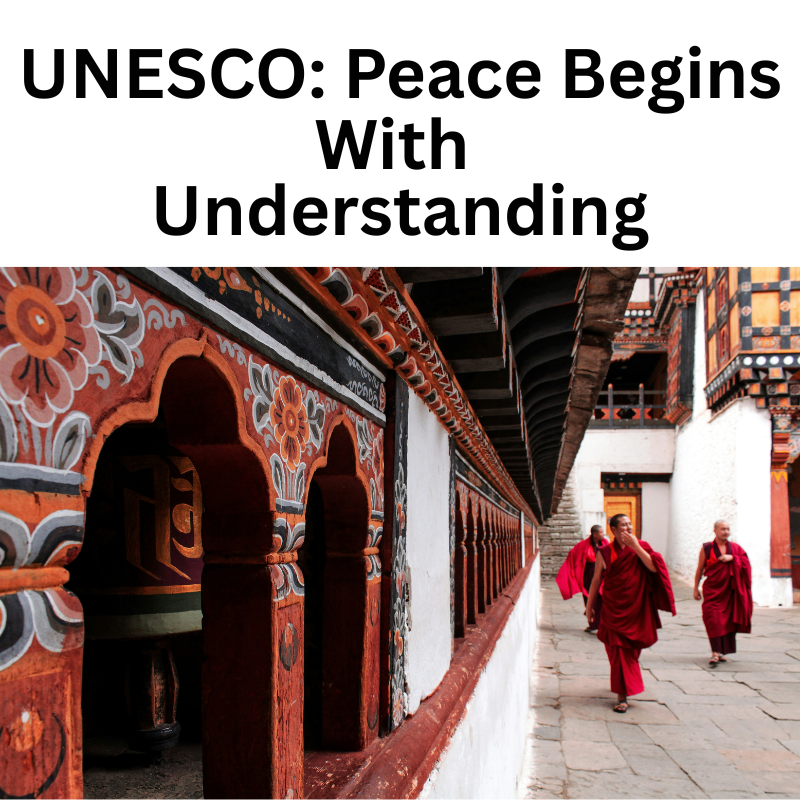
The practical impact of UNESCO’s philosophy is evident in its long-term collaboration with Bhutan to preserve the nation’s distinctive cultural heritage. Bhutan, known for measuring progress through Gross National Happiness rather than purely economic metrics, represents a unique synthesis of spiritual tradition and governance.
UNESCO’s Intangible Cultural Heritage program has supported Bhutan in documenting and preserving ancient Buddhist ritual chants, traditional textile weaving, thangka painting, and masked dance traditions (Cham). These efforts go beyond mere documentation to ensure that living traditions remain economically viable and spiritually intact despite modernization pressures.
This partnership demonstrates UNESCO’s commitment to respecting indigenous knowledge systems and recognizing culture not as a static artifact but as a dynamic resource for community resilience. By helping Bhutan maintain its cultural identity while engaging with global development, UNESCO exemplifies its approach to peace-building through cultural understanding.
The work also illustrates UNESCO’s distinctive methodology – not imposing external models but collaborating with communities to identify and protect what they themselves value. This respectful approach contrasts with earlier paradigms of international development that often marginalized local knowledge in favor of universal technical solutions.
Challenges and Critiques
Like all international organizations, UNESCO faces significant challenges in fulfilling its mandate. Budget constraints have intensified following the United States’ withdrawal of funding in 2011 (though the U.S. has since rejoined), forcing difficult prioritization decisions.
The organization has also navigated complex political tensions, particularly around controversial World Heritage site designations that intersect with territorial disputes. Critics have questioned whether UNESCO’s consensus-based approach can adequately address urgent threats to cultural heritage, especially during armed conflicts.
Additionally, some argue that UNESCO’s broad mandate results in diffuse impact rather than concentrated influence. Others suggest that its emphasis on universal values sometimes struggles to balance global standards with cultural diversity and local autonomy.
Despite these challenges, UNESCO’s distinctive contribution to international cooperation remains vital. Its emphasis on dialogue rather than imposition, on prevention rather than intervention, and on cultural understanding rather than merely political accommodation offers an essential complement to other forms of international engagement.
Looking Forward: UNESCO’s Growing Relevance
As societies worldwide confront polarization, disinformation, and cultural tensions, UNESCO’s founding insight – that peace must be constructed in human minds through shared understanding – appears increasingly prescient. Several emerging global challenges underscore the organization’s continued relevance:
First, the digital transformation of society requires thoughtful governance of information ecosystems. UNESCO’s work on media literacy, open science, and ethical AI provides crucial frameworks for ensuring that technological advancement serves human flourishing rather than exacerbating division.
Second, climate change threatens not only physical infrastructure but cultural heritage as well. UNESCO’s integration of cultural and environmental protection offers models for climate adaptation that respect cultural dimensions of place and identity.
Finally, rising nationalism and populism worldwide challenge the ideal of global cooperation itself. UNESCO’s patient work in cultural dialogue and mutual understanding provides an essential counterweight to narratives of inevitable civilizational conflict.
A Distinctive Peace Architecture
UNESCO’s approach represents a distinctive form of peace architecture – one built not through military deterrence or economic incentives alone, but through the cultivation of shared knowledge, cultural respect, and ethical consensus.
In a world where hard power dominates headlines and short-term crises absorb diplomatic attention, UNESCO reminds us that sustainable peace requires deeper foundations. Its work embodies the recognition that lasting stability emerges not merely from balancing competing interests but from nurturing the cultural and intellectual soil in which cooperation can grow.
As global challenges intensify, this subtle but essential dimension of international relations deserves greater recognition. UNESCO’s quiet power – protecting heritage, connecting cultures, and educating for shared humanity – may ultimately prove among our most effective resources for building a more peaceful world.

